Classical Music Performance
KristiansandDo you want to take your artistic skills to new heights? This Master's programme develops your musical identity while allowing you to delve deeper into what interests you the most.
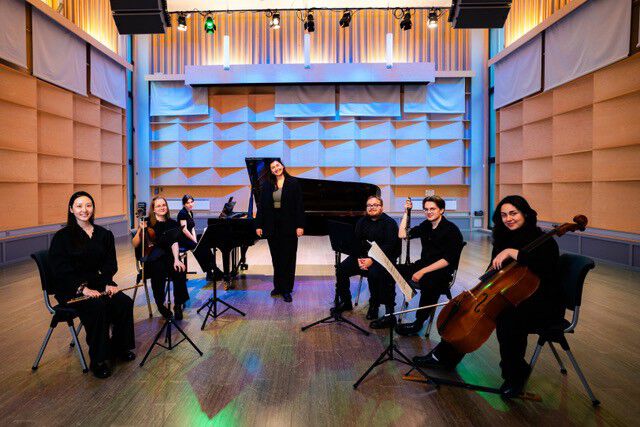
Facts about the program
- ECTS credits:
- 120
- Duration:
- 2 years
- Mode of study:
- Full-time
- Semester:
- Autumn 2027
- Application opens:
- 1 November
- Application deadline:
- 15 December
- Teaching languages:
-
- English
- Norwegian
- Student places:
- 15
About the programme
This master’s programme focuses on your personal artistry as a musician, allowing you to follow your vocational and professional ambitions and offering great opportunities for professional and practical exposure in cooperation with the Kilden Performing Arts Centre, namely the Kilden Vocal Ensemble and the Kristiansand Symphony Orchestra.
Professional internships will develop and nurture your musical growth and open the possibility for feedback and learning from a variety of sources.
Our teachers at the Department of Classical Music and Music Education value your creativity and your desire to learn, and will provide you with a learning environment that enables you to fully polish and cultivate your musical strengths:
Behind the scenes: Get to know our students and teachers here
Specialisations and in-depth fields
UiA’s unique Master’s Programme in Classical Music Performance offers two specialisations:
Artistic Performance Specialisation:
Alongside your principle study/main instrument and depending on your background and qualifications – you can follow one of the following in-depth fields:
- Creative performance
- Ensemble singing
- Orchestral academy
- Collaborative piano
- Classical music improvisation
- Choir conducting
You can read more about each of the in-dept fields in the section "In-depth fields" further down on this page.
Artistic Scientific Specialisation:
Alongside your principle study/main instrument, you can choose a musicological and theoretical module. A topic related to your principle study/main instrument and repertoire can be chosen for your academic work and the successful submission of a Master Thesis will complete the programme.
What will you learn?
- You will develop technical skills as a musician and instrumentalist at a high professional level.
- You will acquire further understanding about the relations between music theory, music history and music performance.
- You develop an academic and professional basis which is crucial to reflection, creativity and innovation in the field of music.
- You will get broad knowledge on how to carry out advanced tasks and projects in the field of music.
- The program provides a comprehensive introduction to the musicological disciplines and how to facilitate research on your own music.
Teaching language
Language of instruction: English
Exchange opportunities
You can go on exchange during your 3rd semester.
This is where you can go on exchange.
Everything you need to know about exchange
Learning environment
We offer a learning environment with strong professional resources. You are exposed to international impulses and get opportunities to participate in national and international projects.
In depth-fields
Creative performance
Creative performance as an area of specialization involves a focus on your solo activity through the main instrument and work with a special theme in relation to your own practice. This can be a specific type of repertoire, a composer, era or style, classical music improvisation or similar. You choose the topic yourself in consultation with the main instrument teacher and/or supervisors on the master's programme.
Development of the student's individuality, distinctive character and awareness of artistic choices and own interpretation will have a consistent focus. Concert activities and project participation will be central.
Through seminars, master classes and workshops, you will work with concert concepts, analysis and work studies, performance practice, instrumental and interpretive issues. Other topics will be musician physiology, repertoire knowledge, interpretation knowledge and relevant issues about tradition and innovation.
A two-year master's course with a specialism in creative performance, prepares you to develop an artistic profile, for and through your own solo activity.
Instrumental teachers at the Department of Classical Music and Music Education are responsible for the main instrument teaching.
Study program leader Jørn Schau is responsible for the in-depth field.
Ensemble singing
With ensemble singing as in-depth field, you will develop singing skills and competence that are in demand within the independent music field as well as by traditional performing institutions.
Examples of ensembles with professional singing positions include the Edvard Grieg Choir in Bergen, Det Norske Solistkor based in Oslo, and the Kilden vocal ensemble here in Kristiansand. The latter ensemble collaborates with the University of Agder and provides unique opportunities for performing practice for UiA's ensemble singing students.
Through seminars, master classes and workshops, you work with industry knowledge, language, repertoire knowledge and score playing, interpretation knowledge and interpretation. Other topics will include musician physiology, pedagogical and psychological aspects and relevant issues around tradition and innovation. Focus on ensemble skills and interaction will be central. In addition, you develop your individual skills in the main instrument (singing) through work with solo repertoire.
With ensemble singing as an in-depth field, you will gain valuable skills with regard to future work situations. UiA is the only institution in Norway with such an offer today.
The singing teachers at the Department of Classical Music and Music Education are responsible for teaching the main instrument.
Orchestral academy
The orchestral academy in-depth field helps string players and wind players to strengthen their performance skills and skills for future work in orchestra positions, and to be able to freelance on the orchestra market.
The department's closest partner is the Kilden theater and concert hall and the Kristiansand Symphonic Orchestra (KSO). A unique agreement between the institutions ensures that orchestral academy students can follow an organized scheme with orchestra practice in the KSO.
You will receive instrumental instruction and will work with audition repertoire and skills in collaboration and orchestral work. Through seminars, workshops and projects, you will work on rehearsal training, rehearsal skills and orchestral playing. Other topics will be score comprehension, repertoire knowledge, musician physiology, interpretation and performance practice. In addition, you get main instrument lessons with a focus on solo repertoire.
A two-year master's course with orchestral academy as in-depth field gives you valuable competence for a future professional situation with orchestral work. You will be prepared for the audition situation, gain important orchestral experience and insight into the working culture in professional orchestras.
Employees at the Department of Classical Music and Music Education, and employees in wind and string solo positions in the Kristiansand Symphony Orchestra, will be responsible for the work with the main instrument.
Adam Grüchot has the professional responsibility for the in-depth field and Anne Camilla Furre Thommessen is the coordinator and practice manager.
Collaborative piano
Collaborative piano focuses on pianists' skills in concert and collaboration within varying ensembles. This includes chamber ensembles with various instruments, but also extends further – with accompaniment and "lied" rehearsal, work as a piano partner for wind players, singers and strings, as a musical theater and opera rehearser, and as a pianist in contemporary ensembles and orchestras.
Through seminars and workshops, we work with rehearsal technique, rehearsal technique and repertoire knowledge for relevant orchestral types. Other topics will be sound processing of various instruments, diction and text understanding in singing, work with style and interpretation knowledge and relevant literature.
There will be a consistent focus on the pianists being able to orientate themselves in a wide range of performing tasks. Through the two-year course, the students are exposed to a program that will strengthen study capacity and musical adaptability, and provide broad performing experience. Participation in performing projects and participation during concerts are central.
To develop in the art of collaboration and to strengthen one's applicability by specializing in interaction, is at the very core of this in-depth field. In addition, the students develop their individual skills in the main instrument through work with solo repertoire.
Piano teachers at the Department of Classical Music and Music Education are responsible for teaching the main instrument.
Professor Cordula Hacke is professionally responsible for the in-depth field and teaching at seminars, master classes and workshops.
Classical music improvisation
Classical music as a term includes music from the Middle Ages to the present day. Improvisation comes from the Latin word unexpected, and is often described as spontaneous performance or real-time composition.
Improvisation has been central to large parts of music history. In the Baroque, notation was a starting point for the musicians' personal ornamentation and realization of the music. Throughout classicism and romanticism, improvisation was also a cornerstone of musicianship. Johann Sebastian Bach, Wolfgang Amadeus Mozart, Ludwig van Beethoven, Clara Schumann, Joseph Joachim and Franz Lizt were all known for their improvisational skills.
As notation became more detailed and elaborate in the 19th century, a greater separation arose between composer and performer. The roles became more defined. Respect for the score, the Urtext and the composer's intention (werktreue) led the performance tradition into a narrower track, where the performer's creativity was put on hold for the sake of the idea of the concept of the work.
Today, there is a living improvisational tradition and practice in only two areas within classical music - within historical performance practice (early music) and in contemporary music.
Classical music has been criticized for developing into a rigid tradition, with an inability to renew itself and a system where musicians preserve, reproduce and perfect a limited number of selected standard works.
One of the movements we see internationally now that aims to renew and revitalize classical music is improvisation. As we can see, it is nothing new, but a return to earlier, unbroken, several-hundred-year-long practice. One is looking back to a holistic musician, a performing and creative musician who can build bridges and find new paths.
Improvisation in classical music varies depending on the context, style and historical era. We will explore many types of improvisation in classical music: through historical examples, improvisation within existing structures, contemporary music improvisation including various forms of free improvisation.
A common thread through these approaches is an improvisational way of thinking, an attitude towards music, which can be used whether you want to rehearse classical works, or create something completely new.
Through working methods such as workshops, one-on-one lessons, solo and ensemble playing, we will explore different ways of improvisation. We will focus on listening as a practice and as a fundamental quality in improvisation.
The objective is to give students knowledge and skills in a number of methods, techniques and strategies for practicing and performing improvisation, and improvising on their main instrument with an independent, personal and creative expression.
The aim is to cultivate musical individuality, freedom and creativity: To play one's own tunes!
Choir conducting
With choir conducting as an in-depth field, you will develop your competence and profile in musical management and direction of choirs, tailored for the voluntary music life. The emphasis is on work with the professional, musical and artistic tasks that the choir director must be able to master in the professional situation. Norway has strong choral traditions in all the country's regions, and the cultural life's need for choir leaders and conductors has been important for the establishment of this specialization area.
The department's closest partner is the Kilden Theater and Concert Hall with, among others, the Kristiansand Symphony Orchestra and the Kilden Vocal Ensemble. Here, the latter, together with other well-established choirs in the region, will provide unique opportunities for performing practice for UiA's choir director students.
Through seminars, master classes and workshops, work is carried out on conducting technique, score understanding, interpretation, rehearsal technique, repertoire knowledge and musician's physiology. Other topics will include pedagogical, methodological and psychological aspects, and relevant issues around tradition and innovation. Development of the student's identity and awareness of the artistic leadership role in work with choirs will have a consistent focus. Students also follow courses with individual tuition in the main instrument.
A two-year master's degree with choral conducting as an area of specialization gives you valuable skills for a work situation particularly geared towards the voluntary music life. In addition, you develop your individual skills in the main instrument through work with solo repertoire.
Instrumental teachers at the Department of Classical Music and Music Education are responsible for the main instrument teaching.
Career prospects
What can you do with your degree?
Upon completed course you will earn a master's degree in music performance. The program qualifies to work as a professional musician, as well as for creative and artistic work in the arts and cultural sector. It is a good starting point for a musical career. Completed master's degree may qualify to attend studies on a higher level, such as the PhD program at the University of Agder.
Further studies
A completed Master’s degree in Classical Music Performance qualifies for example, for PhD-level work at the Faculty of Fine Arts at UiA.
-
A Multifaceted Musical Career
After studying classical music at the University of Agder, Sivert has built a varied and versatile career as both a musician and teacher.

Admissions
The application period for international students is 1 November to 15 December.
Admission requirements
The general admission requirement is a bachelor's degree or equivalent education of at least three years (180 credits). The admission criteria must include specialisation unit of at least 80 credits in performing music or equivalent. At least 20 credits in the specialization unit must be level 2. Ranking of applicants takes place on the basis of an entrance exam with the following parts:
- Audition with self-selected program. In the audition, a score from 10 to 20 is given for passing the test. Applicants who get less than 10 points have not passed the audition. The audition counts for 50% of the total score.
- Interview. At the interview, a score is given from 10 to 20. The interview counts for 50% of the total score. The audition must be passed in order to be admitted to an interview.
See information about auditions.
Recommended previous knowledge
MUK107 Philosophy of Science, Aesthetics and Analysis at UiA, or similar.
How to apply
How to apply to degree programmes
The Section for Admissions at UiA can answer questions about the application process. For questions about the programme itself, please contact your faculty. See the contact details at the bottom of this page.
Contact the Section for Admissions
Phone: +47 38 14 15 64
Phone hours: Monday - Wednesday - Friday 9:00 - 11:00
Tuition fees
Tuition fees are applicable to international students with citizenship from outside the EU/EEA or Switzerland.
Contact

- mie.g.reibo@uia.no
- Phone
- +47 38 14 24 09

- jorn.e.schau@uia.no
- Phone
- +47 38 14 19 14

- pia.goul@uia.no
- Phone
- +47 38 14 24 12